Key Takeaways
- A valid import license, compliance with UAE product and phytosanitary standards, and a complete set of shipping and certification documents are required to import agricultural products from India into the UAE.
- Most shipments qualify for reduced or zero customs duty under the India-UAE CEPA, provided the correct certificate of origin is used to claim it.
- Without CEPA, the standard UAE customs duty is 5% of the CIF value, plus 5% VAT calculated on the CIF value plus duty.
- Every shipment needs a consistent document set, including a commercial invoice, packing list, bill of lading, certificate of origin, and, where relevant, health and phytosanitary certificates and an import permit.
- At SPC Free Zone, a general trading license starts from AED 6,875, and our own address is sufficient for licensing and banking without a separate warehouse lease.
Importing agricultural products from India into the UAE requires a valid import license, compliance with UAE product and phytosanitary standards, and a complete set of shipping and certification documents at customs. Most shipments also qualify for reduced or zero customs duty under the India-UAE Comprehensive Economic Partnership Agreement, provided the correct certificate of origin is used to claim it.
This guide covers the regulations that apply, what compliance actually costs, and how to use the CEPA correctly so you’re not paying duty you don’t owe.
Table of Contents
- Understanding UAE Import Regulations for Agricultural Products
- How the India-UAE CEPA Affects Your Import Costs
- Documents You Need for Every Shipment
- What It Costs to License and Operate an Import Business
- Compliance Tips for a Smooth Import Operation
- Why Import Through SPC Free Zone
- Frequently Asked Questions
Understanding UAE Import Regulations for Agricultural Products
Agricultural imports into the UAE, including live plants, seeds, fresh produce, and plant-based goods, fall under the Ministry of Climate Change and Environment’s oversight, alongside live animals, fertilisers, and pesticides. Products must meet UAE quality and safety standards, and certain categories require pre-shipment inspection or an import permit before the goods leave India.
The specific licensing and permit requirements vary by product type. Fresh produce, processed foods, and seeds each carry different documentation, so confirming the exact requirement for your product before shipping avoids a rejected consignment at the port.
How the India-UAE CEPA Affects Your Import Costs
The India-UAE Comprehensive Economic Partnership Agreement, in force since 1 May 2022, eliminates or reduces customs duty on the large majority of Indian goods entering the UAE. Agricultural and processed food products are among the categories the UAE committed to liberalising, alongside textiles, gems, and engineering goods.
Without CEPA, the standard UAE customs duty is 5% of the CIF value of your shipment, the cost of the goods plus insurance and freight. VAT of 5% applies on top of that, calculated on the CIF value plus duty.
To claim the preferential CEPA rate instead of the standard 5%, your exporter needs to issue a preferential Certificate of Origin that specifically references the CEPA, generated through India’s eCoO 2.0 system. A standard, non-preferential Certificate of Origin does not qualify you for the reduced rate, and UAE customs will default to charging the standard duty if the correct certificate isn’t presented.
Documents You Need for Every Shipment
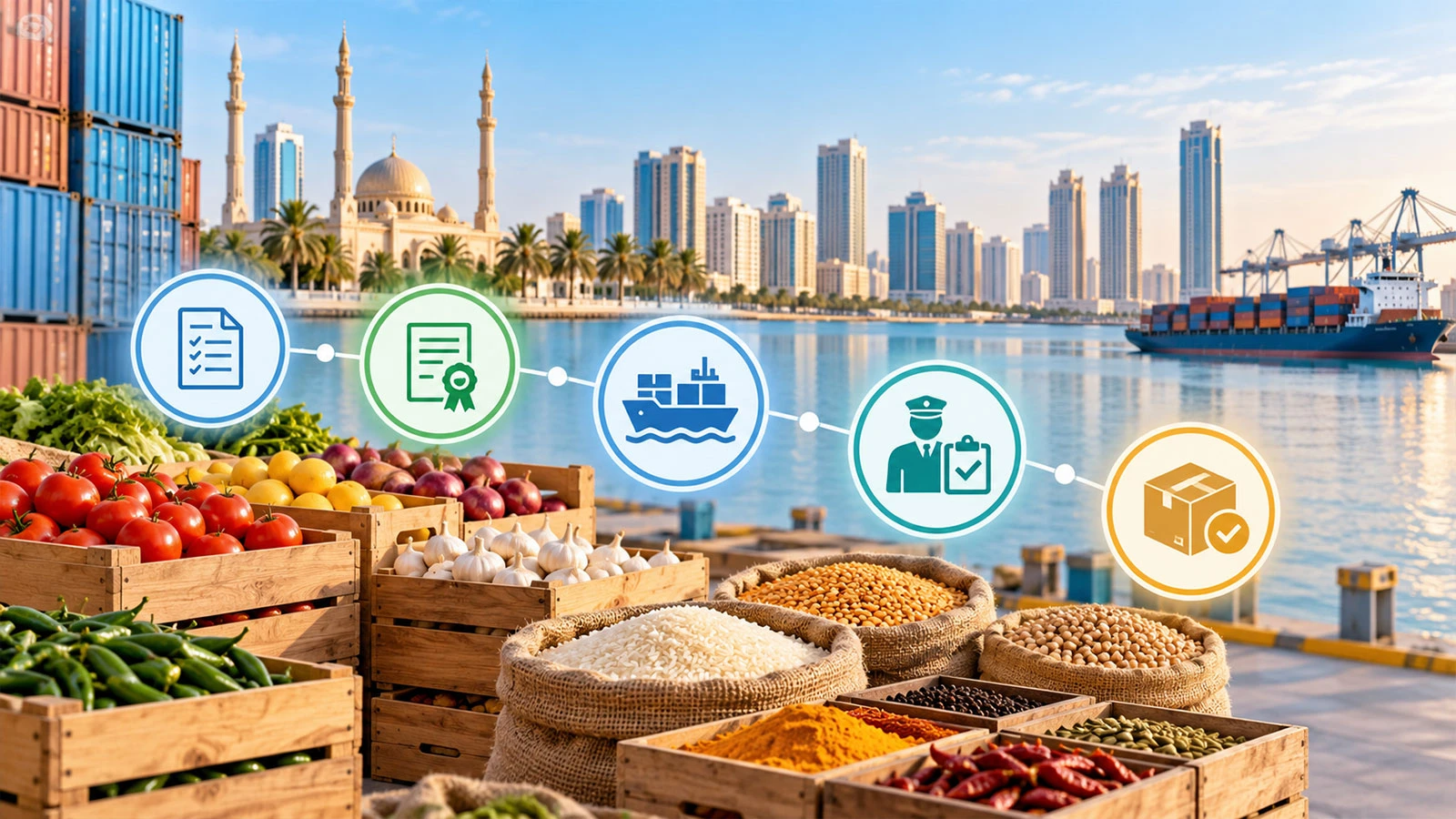
Every agricultural import needs a consistent document set, regardless of product type:
Commercial invoice and packing list:
These establish the transaction value used to calculate duty and VAT.
Bill of lading:
Your proof of shipment and the basis for customs clearance.
Certificate of origin:
A standard certificate for the default 5% duty rate, or a CEPA-preferential certificate through eCoO 2.0 if you want the reduced rate.
Health certificate:
Required for perishable goods, confirming the product meets food safety standards at origin.
Phytosanitary certificate:
Required for plant-based products, confirming the shipment is free of regulated pests and diseases.
Import permit:
Required for many agricultural product categories before the shipment leaves India, obtained in advance rather than at the point of entry.
What It Costs to License and Operate an Import Business
At SPC Free Zone, setting up to import agricultural products breaks down like this:
| Item | Cost (AED) |
|---|---|
| General trading license (from) | 6,875 |
| E-channel registration (for import/export activity) | 2,280 |
| Establishment card (2 years) | 640 |
| Visa allocation fee (per visa) | 1,600 |
On top of licensing, factor in the standard 5% customs duty (unless your shipment qualifies for the CEPA preferential rate) and 5% VAT on the CIF value plus duty. Run your own numbers on the cost calculator to estimate your full setup cost before you commit.
Want to know your exact setup cost?
Plug in your activities and visa count for a real number in under a minute.
Compliance Tips for a Smooth Import Operation
- Confirm requirements before you ship, not after. Product standards and permit requirements vary by product, and a shipment that arrives without the right certification can be delayed or rejected at the port.
- Work with a customs broker who knows agricultural imports specifically. General import experience doesn’t always cover the phytosanitary and health certification requirements this category carries, and a broker who has streamlined this process before catches issues before they reach the port.
- Keep your labelling compliant from the start. Product information, ingredient lists, and nutritional labels need to be accurate and available in English or Arabic, and mislabelled shipments face the same rejection risk as missing certificates.
- Use the CEPA certificate correctly, every time. A single shipment with the wrong certificate of origin pays the standard 5% duty instead of the preferential rate, so this is worth getting right on every consignment, not just the first one.
- Build in time for customs inspection. Even complete, compliant shipments go through inspection, and factoring that time into your supply chain planning avoids downstream delivery pressure.
Why Import Through SPC Free Zone
At SPC Free Zone, general trading and import-export activities can be licensed alongside our customs code service, which streamlines the registration import businesses need with UAE Customs. Our own address is sufficient for licensing and banking, so wholesalers don’t need a separate warehouse lease just to hold a trade license, and storage can be arranged separately based on your actual volume.
We also support businesses setting up specifically from India, including guidance on structuring your UAE entity to work alongside your existing Indian operations. Talk to our business setup team if you’d like help matching your product category to the right licensing and compliance path.
Not sure which licence your product needs?
Our setup team can match your product category to the right licensing and compliance path.
Frequently Asked Questions
1. Does CEPA cover all Indian agricultural products, or only specific categories?
Agricultural products are among the categories the UAE committed to liberalising under CEPA, but coverage and rates vary by specific product, so confirming your product’s tariff line before shipping is worth doing rather than assuming.
2. What happens if my exporter sends a standard certificate of origin instead of a CEPA one?
UAE customs will charge the standard 5% duty rather than the preferential rate, since the reduced rate only applies when the certificate specifically references CEPA through India’s eCoO 2.0 system.
3. Can a free zone company import agricultural products directly to mainland UAE customers?
Generally, this requires either a distributor arrangement or a dual license, since a standard free zone license covers sales within the free zone and internationally rather than direct mainland retail.
4. Do perishable shipments get any priority in customs clearance?
Perishable goods are handled with awareness of their shelf life, but they still require complete documentation, including a valid health certificate, before release, so the fastest clearance still depends on preparation rather than product type alone.
5. Is VAT charged on top of customs duty, or instead of it?
Both apply together. VAT is calculated on the CIF value plus any customs duty owed, not as an alternative to it.