Key Takeaways
- A UAE food business needs two separate approvals, a trade license and a food establishment permit, both in place before you can legally serve or sell food.
- SPC Free Zone licensing starts from AED 6,875, with additional costs for visas, the establishment card, and medical fitness tests.
- Getting the trade license first and the food permit second is the standard order, since the permit application typically requires an active license and a confirmed premises to inspect.
- Cloud kitchens cut upfront investment and staffing needs by eliminating front-of-house costs, while food trucks require a mainland permit rather than free zone licensing.
- Every staff member working with food needs a valid occupational health card, and commercial kitchens generally require HACCP-based food safety documentation.
Starting a food business in the UAE requires two separate approvals: a trade license covering your food activity, and a food establishment permit from the relevant municipal food safety authority confirming your kitchen and processes meet UAE food safety standards. Both need to be in place before you can legally serve or sell food.
This guide covers what those approvals cost, how to choose between dine-in, cloud kitchen, and food truck models, and what to plan for on staffing and equipment.
Table of Contents
The Two Licenses Every UAE Food Business Needs
A trade license alone doesn’t let you serve food. You also need a food establishment permit, which confirms your premises, equipment, and food safety processes meet the standards set by the relevant municipal authority.
HACCP-based food safety documentation is generally required for commercial kitchens, and staff need valid occupational health cards before they can work. Each emirate’s municipality runs this process separately, Dubai Municipality, Abu Dhabi’s food safety authority, and Sharjah Municipality each issue and inspect under their own local framework, though all sit under the same federal food safety law.
Getting the trade license first and the food permit second is the standard order, since the food permit application typically requires an active license and a confirmed premises to inspect.
What It Costs to License a Food Business
At SPC Free Zone, the licensing side breaks down like this:
| Item | Cost (AED) |
|---|---|
| Business license (from) | 6,875 |
| Standard License + 1 employment visa | 14,290 |
| Establishment card (2 years) | 640 |
| Visa allocation fee (per visa) | 1,600 |
| Medical fitness test (per person) | 365 |
On top of licensing, budget separately for your food establishment permit and any required HACCP certification, which independent food safety consultants typically price in the range of AED 5,000 to AED 9,000 for a small operation, depending on scope.
Choosing Your Business Model
According to IMARC Group, the UAE’s food service market was valued at USD 18.60 billion in 2025 and is projected to keep growing at a double-digit rate through 2034, with digital ordering now the default mode for a growing share of consumers.
Dine-in restaurants need the highest staffing levels and the largest upfront investment in fit-out, furniture, and front-of-house equipment, but they capture walk-in demand a delivery-only model can’t.
Cloud kitchens eliminate front-of-house costs entirely, cutting the upfront investment and staffing requirement significantly while relying on third-party platforms like Talabat or Deliveroo for reach. This model has grown quickly precisely because it lets an operator test a concept without committing to a full restaurant fit out.
Food trucks require a mainland permit and location approval from the relevant municipality, since operating a mobile food vehicle sits outside standard free zone or fixed-premises licensing.
Staffing and Equipment to Plan For
Staffing needs scale with your model. A dine-in restaurant needs front-of-house and kitchen staff; a cloud kitchen needs kitchen staff only, which meaningfully reduces headcount and visa costs.
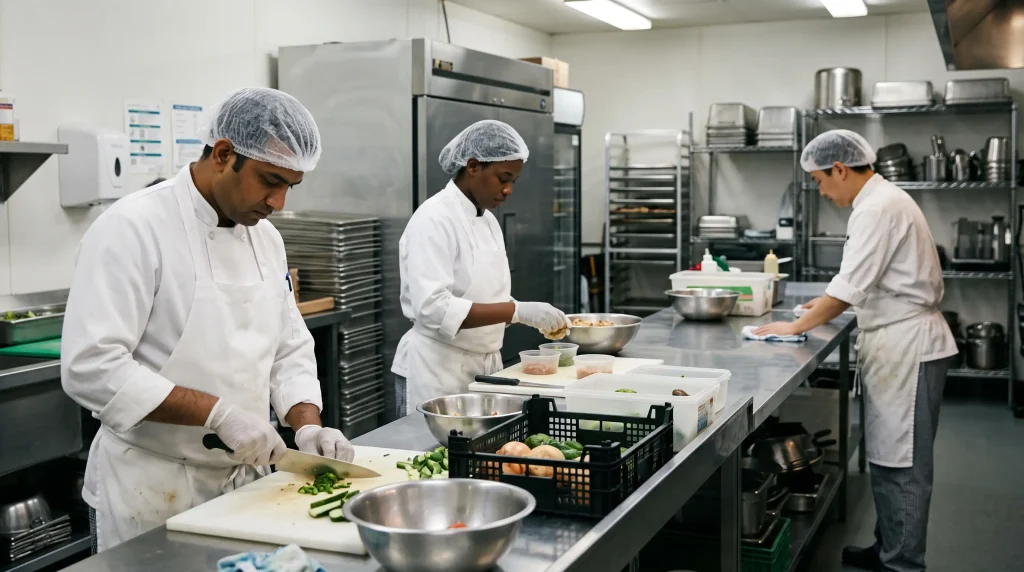
Every staff member working with food needs a valid occupational health card, obtained through municipality-approved training, before they can start.
Equipment requirements centre on commercial kitchen hardware, refrigeration, ovens, and preparation equipment suited to your cuisine, plus order and payment systems that integrate with whichever delivery platforms you plan to use. Budgeting for this equipment realistically, rather than as an afterthought once the license is issued, avoids a gap between licensing and actually opening.
Commercial-grade equipment also has to meet the finish and material standards municipal inspectors check for, stainless steel or an approved impervious surface for prep areas, adequate refrigeration capacity, and proper separation between raw and cooked food zones. Sourcing equipment that already meets these standards costs less to adjust later than retrofitting a kitchen after a failed inspection.
Why Set Up Through SPC Free Zone
At SPC Free Zone, we license food businesses with 100% ownership for non-GCC nationals, with a business license available from AED 5,750 and a Standard License plus one employment visa from AED 14,290. Multi-year packages come with license terms of up to 10 years.
Additional costs, including the establishment card, visa allocation fee, and medical fitness test, are budgeted separately alongside your food establishment permit. Use our cost calculator to work out the full package for your food business, and check our business activities list to confirm the correct activity code before you apply.
Confirm your activity code before you apply
Browse the full list of approved business activities to find the right one for your food concept.
Frequently Asked Questions
1. Can I apply for my food establishment permit before my trade license is issued?
Generally no, since the food permit application typically requires an active trade license and confirmed premises for inspection, so sequencing the license first avoids a stalled application.
2. Does a cloud kitchen need the same HACCP documentation as a full restaurant?
Yes, HACCP-based food safety documentation applies to commercial kitchens regardless of whether customers dine in, so a cloud kitchen isn’t exempt just because there’s no dining room.
3. Can I operate a cloud kitchen under a free zone license?
Yes, a cloud kitchen with no walk-in dine-in component fits well under a free zone structure, since it doesn’t require the mainland presence a physical storefront serving walk-in customers typically needs.
4. How long does it realistically take to open, from license application to serving customers?
Timelines vary by model and premises readiness, but factor in inspection time for your food establishment permit on top of your trade license timeline, since a failed inspection adds weeks while you remediate and rebook.
5. Do I need a separate license if I sell packaged food products rather than prepared meals?
Generally, yes, foodstuff trading and food preparation are typically licensed as distinct activities, so confirm the correct activity code for your specific product before applying.